10624 : A Buddy for Every Task: Peer Buddies in the Music Room
- Shipping:
- Calculated at Checkout
- Seller:
- MusicKamp





Description
ou already know the power of a good peer connection.
You've seen it happen — a student who struggles to settle in suddenly relaxes the moment a familiar classmate sits down beside them. A student who holds back starts participating when someone they trust is nearby. A student who felt invisible in the music room starts to belong.
That's not luck. That's a peer buddy system — and when it's done intentionally, it's one of the most research-supported strategies available to music educators working with students with ASD.
But good peer buddy systems don't happen by accident. And most music teachers were never taught how to build one.
A Buddy for Every Task: Peer Buddies in the Music Room was written for you.
This research-backed educator guide gives elementary music teachers the knowledge, framework, and real classroom tools to build meaningful peer buddy partnerships — the kind that support students with ASD, grow confident and compassionate neurotypical students, and strengthen the community of your entire music room. Written by a National Board Certified music teacher with a Master of Music in Music Education from the Boston Conservatory at Berklee, every strategy in this resource is grounded in peer-reviewed research and real classroom experience.
This is not a general inclusion guide. Every concept, every example, and every tool was built with the music room in mind.
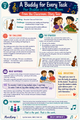
WHAT'S INCLUDED (11 pages):
6 Components designed to give you everything you need to build, run, and sustain a peer buddy system that actually works.
Component 1 — Educator Reference Guide What peer buddies are, why careful selection matters, the roles of everyone involved (the student with ASD, the neurotypical peer buddy, and the adults in the room), the research base for why peer buddy systems work, and the most important principle guiding all of it: the goal is always independence, not dependence.
Component 2 — Benefits for Neurotypical Peer Buddies A two-sided deep dive into what neurotypical students gain from serving as peer buddies — because this is a two-way street. Covers the development of empathy and perspective, leadership and responsibility, friendship and community, and confidence and communication skills. Includes a reminder that neurotypical buddies need preparation, clear expectations, and regular check-ins to thrive in the role.
Component 3 — Watch Out for Buddy Fatigue + Do's & Don'ts What buddy fatigue is, how it develops, why it matters, and how to prevent it through variety and rotation. Includes a complete Do's & Don'ts quick-reference guide covering selection, training, expectations, routines, and student voice — everything you need to set the system up right from Day One.
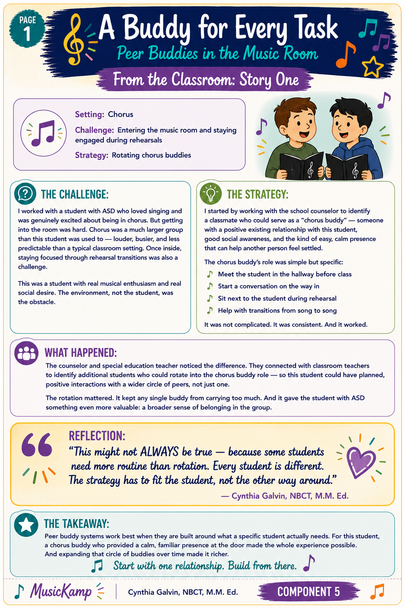
Component 5 — From the Classroom: Story One & Story Two Real classroom narratives — one from a chorus setting, one spanning recorder class and violin — showing exactly how peer buddy strategies were introduced, what roles were defined, what happened, and what the outcomes reveal about connection, independence, and belonging. Includes honest reflections on what worked, what to watch for, and why the strategy has to fit the student — not the other way around.
Component 6 — Looking Ahead: Planning for the Future Bigger-picture questions and considerations across three focus areas: Implementation (how to actually put the system in place), Ethical Considerations (disability disclosure, student autonomy, and stakeholder communication), and Student Learning (how to make sure the buddy system is supporting growth for everyone involved). Includes a critical note on student self-determination — and why honoring a student's right to choose matters as much as the strategy itself.
Full Works Cited Page — APA-formatted references for every source cited throughout the guide.
THIS RESOURCE IS PERFECT FOR:
- Elementary music teachers (K–5) who want to build intentional peer connections for students with ASD in their music room
- Music educators who have tried informal "buddy" arrangements but want a research-grounded framework to make them more effective
- Music specialists preparing to collaborate with special education teachers, counselors, or parents on a peer support plan
- Any music teacher who believes that building community is part of the job — and wants the tools to do it well
WHY THIS RESOURCE IS DIFFERENT:
✔ Written by a music teacher for music teachers — not adapted from a general education or therapy-setting template
✔ Grounded in peer-reviewed research, with full citations included and organized by component
✔ Addresses buddy fatigue directly — the pitfall most resources never mention, and the most common reason peer buddy systems break down
✔ Covers what neurotypical students gain — not just what students with ASD receive — because a great buddy system is good for everyone
✔ Includes real classroom stories that show the strategy in practice, with honest reflection on what to watch for and how to adjust
✔ Raises the ethical questions — disability disclosure, student autonomy, and the right to self-determination — that thoughtful educators need to be thinking about
✔ Designed to be built into your classroom culture all year, not rolled out once and forgotten
A NOTE ON FORMAT: This resource is a high-quality, designed PDF. It is an educator reference and planning guide — not a set of student-facing worksheets or activity pages. It is designed to deepen your understanding of peer buddy strategies and give you a clear, research-grounded framework for implementing them in your music room.
For personal classroom and professional development use only. Not for redistribution.
Because together, every student can shine.
Related Products
Related Products

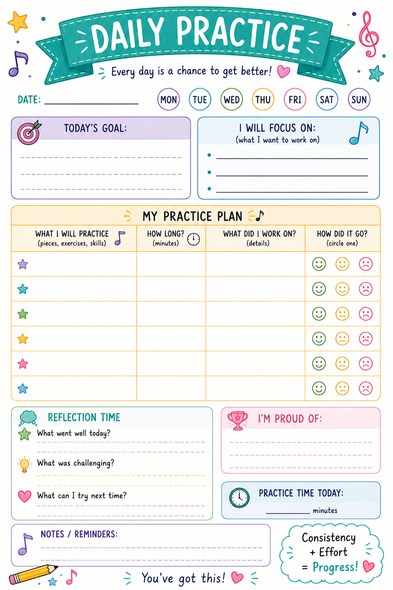
10624 : Ultimate Music Practice Bundle — Practice Buddy Journal + 52-Week Music Practice


Bud, Not Buddy


Be a Buddy-Not a Bully


Bud, Not Buddy - Jeopardy