
STEM Basics: How to Use a Compound Microscope Lab (SB9) | Middle School Science (Grades 6-8)

- Teacher Seller:
- Innovative Middle School STEM
- Grades:
- 6-8
- Product Type:
- Pages:
- 9




Description
? STEM BASICS: HOW TO USE A COMPOUND MICROSCOPE LAB (SB9)
7-Page Printable STEM Skills Packet | Print-Ready PDF Format
Equip your middle school science students with essential optical microscopy skills using this plug-and-play Microscope Mechanics & Slide Focus Precision Toolkit (SB9)! Engineered specifically for grades 6–8, this comprehensive 7-page skills packet eliminates slide-crushing focus errors and turns careless handling into precise laboratory habits.
Using international scientific standards and life science principles, students learn compound microscope anatomy, master the low-to-high power focusing sequence, adjust iris diaphragm lighting, calculate total magnification, and map optical image inversion effects.
? WHAT'S INCLUDED IN THE 7-PAGE SKILLS ANATOMY:
-
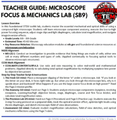
? Page 1: Teacher Guide & Lesson Overview: Skills background, NGSS goals (MS-LS1-1), CCSS math connections, and safety guidelines.
-
? Page 2: Student Mission Profile (The Hook): Real-world microscopy technician scenario detailing accuracy parameters, lens protection rules, and focus constraints.
-
? Page 3: Microscope Anatomy & Optical Magnification Sheet: Pre-lab worksheet to diagram microscope parts, total magnification math, and optical inversion.
-
? Page 4: Laboratory Operation & Step-by-Step Procedure: Standalone card detailing lens cleaning, low-power focusing steps, diaphragm light checks, and fine-focus transitions.
-
? Page 5: Measurement Practice Log & Field Data Matrix: Data worksheet for total magnification calculations, optical inversion maps, and field-of-view sketches.
-
? Page 6: Teacher Lab Metrology Cheat Sheet: Solutions for stage safety stops, black-screen troubleshooting, dirty lenses, and prepared slide sourcing.
-
? Page 7: Microscopy Metrology Master Rubric: 4-point grading rubric evaluating focus protocols, magnification math, field observations, and technical mastery.
? CORE STEM LAB SKILLS COVERED:
-
Compound Light Microscope Mechanics and Component Navigation
-
Executing the Low-to-High Power Focusing Protocol
-
Calculating Total Magnification Ratios (Ocular Eyepiece x Objective Lens)
-
Optimizing Light Apertures using the Iris Diaphragm and Mapping Optical Inversion
? WHY TEACHERS LOVE THIS RESOURCE:
-
Prevents Broken Glass Slides & Cracked Lenses: Emphasizes using fine focus exclusively on high power, protecting your school's expensive microscope equipment!
-
Teaches the Inversion Effect: Clear, hands-on mapping of how lenses flip images upside down and backward, eliminating student confusion.
-
Flawless Independent Flow: Isolated procedure cards keep student lab groups self-directed.
-
Format: High-resolution, print-ready PDF format (7 Pages).
Target Grades: 6th, 7th, 8th / Middle School
Subject Area: Life Science, General Science, Lab Measurement Skills, Optical Microscopy & Biology
Please visit my Amped Up Learning store: https://ampeduplearning.com/teacher-contributor-stores/science-contributors/innovative-middle-school-stem/
Related Products
Related Products


STEM Basics: How to Use a Pipette Liquid Transfer Lab (SB10) | Middle School Science (Grades 6-8)


STEM Basics: How to Use a Stopwatch Precision Timing Lab (SB7) | Middle School Science (Grades 6-8)


STEM Basics: How to Use a Spring Scale Force Lab (SB8) | Middle School Science (Grades 6-8)


STEM Basics: How to Use a Multimeter & Circuit Diagnostics Lab (SB4) | Middle School Science (Grades 6-8)

