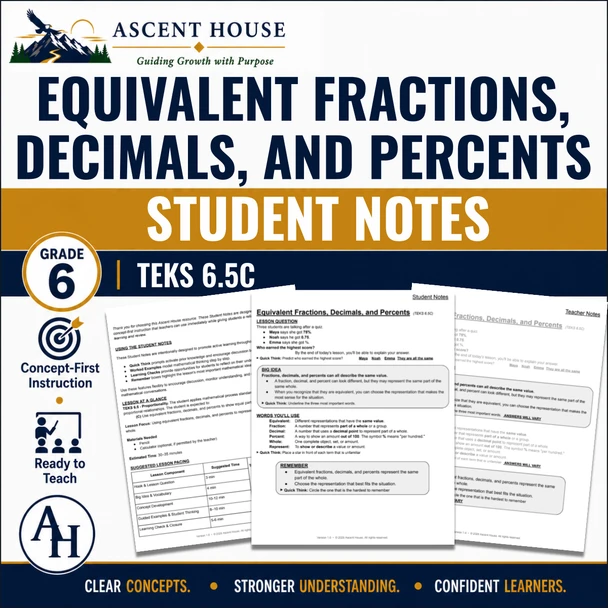
Equivalent Fractions, Decimals & Percents Student Notes | Grade 6 Math | TEKS 6.5C



Description
Equivalent fractions, decimals, and percents can look different while representing the exact same value. Helping students recognize and explain those connections builds the conceptual understanding they need for proportional reasoning.
These Grade 6 Student Notes provide clear, concept-first instruction for using equivalent fractions, decimals, and percents to represent equal parts of the same whole.
Designed around TEKS 6.5C, the resource combines structured student notes, active-thinking prompts, visual models, worked examples, checks for understanding, and substantial teacher support in one ready-to-teach lesson.
WHAT STUDENTS WILL LEARN
Students will:
• Explain how fractions, decimals, and percents can represent the same value
• Identify equivalent fractions, decimals, and percents
• Use visual models to connect equivalent representations
• Show the same part of a whole in different forms
• Explain why different representations are equivalent
WHAT'S INCLUDED
Teacher Guide
• Lesson focus and full TEKS alignment
• Suggested 30–35 minute lesson pacing
• Materials and prior knowledge
• Big Mathematical Idea and Teacher Wisdom
• Common misconception guidance
• Suggestions for continuing the learning
Student Notes
• Lesson Question and Quick Think prompts
• Student-friendly vocabulary
• Conceptual connections among fractions, decimals, and percents
• 100-grid, bar-model, and number-line representations
• Worked examples and Remember prompts
• Learning Check and lesson reflection
Teacher Notes & Answer Key
• Completed teacher version of the Student Notes
• Worked mathematical steps and solutions
• Suggested responses where appropriate
• Teacher-facing support for guiding student thinking
11-page printable PDF
HOW THE RESOURCE WORKS
These Student Notes are designed to keep students thinking throughout the lesson, not simply copying information.
Students begin with a Lesson Question and Quick Think prompt that activate prior knowledge and establish a purpose for learning. As the lesson develops, students:
• Build conceptual understanding before focusing on procedures
• Connect equivalent fractions, decimals, and percents
• Use visual models to see how different forms represent the same part of a whole
• Use Quick Think prompts to predict, notice, and explain
• Use Remember boxes to reinforce important mathematical ideas
• Complete a Learning Check to reflect on their understanding
• Return to the original Lesson Question to connect and summarize their learning
The result is a purposeful progression from question → concept → practice → check → reflection.
MORE THAN AN ANSWER KEY
Strong first instruction requires more than knowing the correct answer.
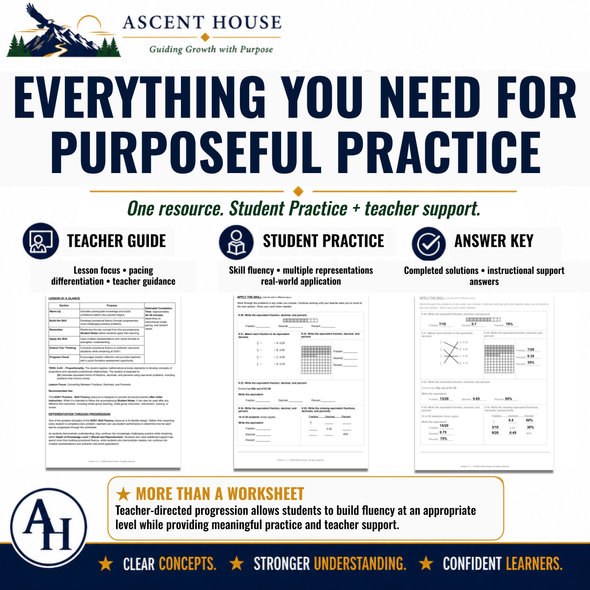
The included Teacher Guide and Teacher Notes & Answer Key provide support for planning, instruction, and responding to student thinking. Teachers receive:
• A clear lesson focus and suggested instructional pacing
• The Big Mathematical Idea behind the lesson
• Prior-knowledge considerations
• Guidance for addressing common misconceptions
• Teacher Wisdom focused on conceptual understanding
• Worked mathematical steps and solutions
• Suggested responses for open-ended student thinking
• Ideas for extending learning beyond the Student Notes
The teacher-facing materials are designed to support professional judgment, not replace it, giving teachers useful guidance while preserving the flexibility to respond to the students in front of them.
SUGGESTED CLASSROOM USES
• Whole-group first instruction
• Guided instruction
• Interactive or structured student notes
• Small-group instruction
• Intervention and reteaching
• Review and reinforcement
• Student reference after the lesson
• Preparation for additional skill practice and application
The Student Notes provide approximately 30–35 minutes of core instruction, leaving additional class time for practice, small-group support, intervention, or enrichment.
STANDARDS ALIGNMENT
Grade: 6 Mathematics
Standard: Texas Essential Knowledge and Skills (TEKS) 6.5C
Strand: Proportionality
TEKS 6.5C: Use equivalent fractions, decimals, and percents to show equal parts of the same whole.
RESOURCE DETAILS
Resource Type: Student Notes
Format: Printable PDF
Pages: 11
Teacher Guide: Included
Teacher Notes & Answer Key: Included
Related Products
Related Products

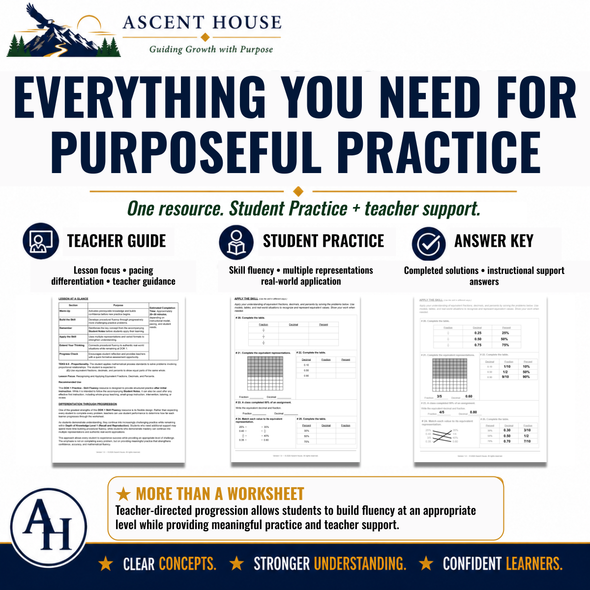
Equivalent Fractions, Decimals, and Percents DOK 1 Practice | Grade 6 Math | TEKS 6.5C


Equivalent Fractions, Decimals, and Percents DOK 2 Practice | Grade 6 Math | TEKS 6.5C
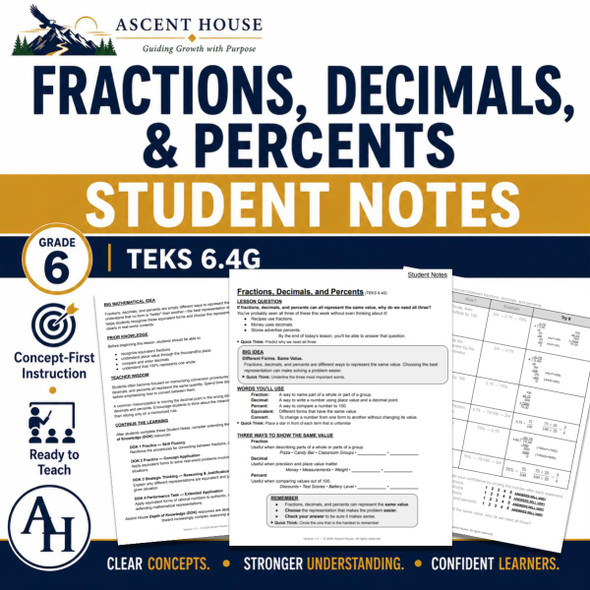

Fractions, Decimals, and Percents Student Notes | Grade 6 Math | TEKS 6.4G
Fractions, Decimals, and Percents DOK 2 Practice | Grade 6 Math | TEKS 6.4G