Owl Pellet Dissection Lab & Owl Unit: Bone Chart, Dichotomous Key, & Food Web
- Contributor:
- Teacher Toy Shop
- Grade Level:
- 5-8
- Product Type:
- PDF and Google Slides




Description
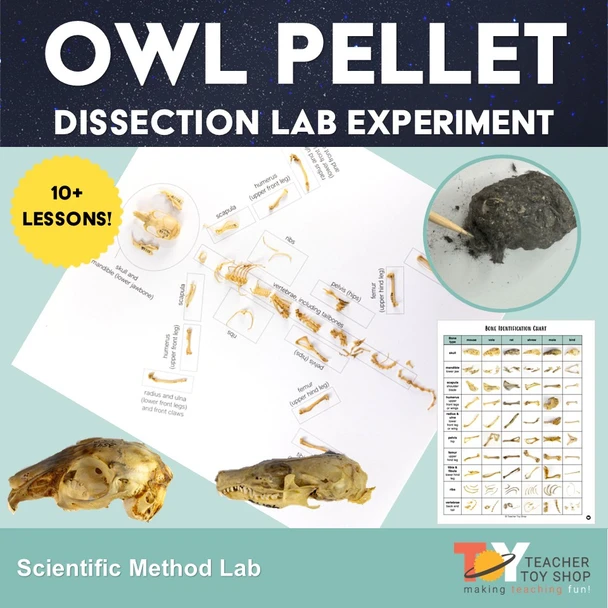
A comprehensive owl pellet unit with an AMAZING bone chart and tons of activities to identify skeletal bones during an owl pellet dissection! This resource includes an owl pellet bone sorting chart with photographs of REAL bones. The photos are in color and have been optimized for B&W printing. The lab is filled with important activities for doing an owl pellet dissection, such as: a reading passage about barn owl digestion with comprehension questions and a diagram of the owl digestive system to label, a step-by-step dissection lab that utilizes the scientific method and is EASY for students to follow, a dichotomous key for identifying the bones, activities with graphic organizers such as Venn diagrams to learn how to identify the prey in the style of forensic science, practice with bar and line graphs to understand ecosystems and wildlife biology, understanding of predator-prey relationships and food chains, comparing skeletal systems across animals and identifying bones, calculating biomass, and more. You and your students will love this lab. Scaffold the learning: the activities are in order of increasing difficulty so you can choose to use only some or all of them.
► What's Included?
- Pre-Lab Teacher Directions
- Reading passage about barn owls and their pellets, including a Parts of the Owl Digestive System plus an 11-question assessment of reading comprehension
- 11-page Owl Pellet Dissection lab that follows the scientific method
- Owl Pellet Bone Sorting Chart with photographs of REAL bones of 6 prey animals that are commonly found in pellets. The bones are from the behind-the-scenes collection at the Natural History Museum of Los Angeles County! The photos were taken with specialized macro photography to provide up-close detail.
- Dichotomous Key to identify the skulls with yes or no questions
- Skeletal System Comparative Anatomy Activity to learn the bones of the body
- Activity: Using Teeth for Identification to distinguish rodents from non-rodents. Includes a graphic organizer Venn Diagram Activity
- Activity: Observing skull characteristics to distinguish shrews and moles. Includes an additional Venn Diagram Activity
- Activity to re-create a complete skeleton using bones found in the pellet
- Bar Graphing activity
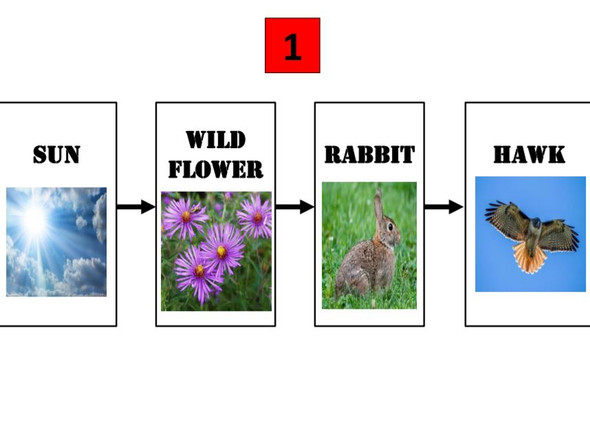
- Food Chain activities
- Line Graph activity
- Calculating the percentage of prey in an owl's diet using biomass
- Vocabulary defined in kid-friendly terms plus a vocabulary crossword puzzle.
- 4 Open-Ended Writing Prompts
- Answer Keys to everything
- Post-Experiment Teacher Notes
- both printable and digital options
Students learn to distinguish mice, voles, rats, shrews, moles, rabbits, and birds by learning about the unique features of each animal skeleton, particularly the skulls. They get a comprehensive experience in dissection and understanding the implications of what they find.
I can't stress enough the unique and helpful feature of having a bone identification chart with PHOTOS of ACTUAL BONES. Print in b&w, or project the color version, or print in color and put in plastic sleeves to use year after year.

Related Products
Related Products
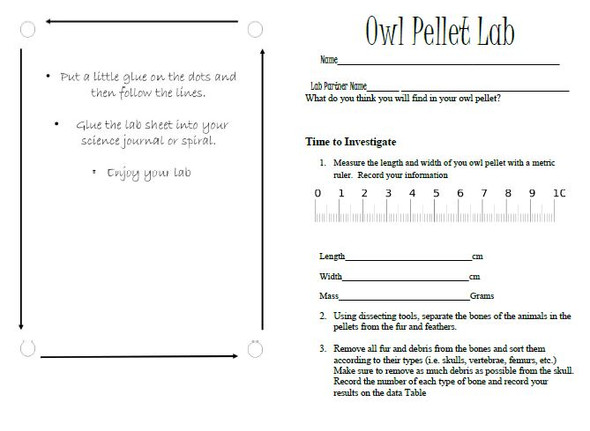
Owl Pellet Lab


Classroom Birthday Chart - Owl Theme


Parts of a Flower Dissection Science Lab


OWL MOON BY JANE YOLEN READING & INTERDISCIPLINARY UNIT