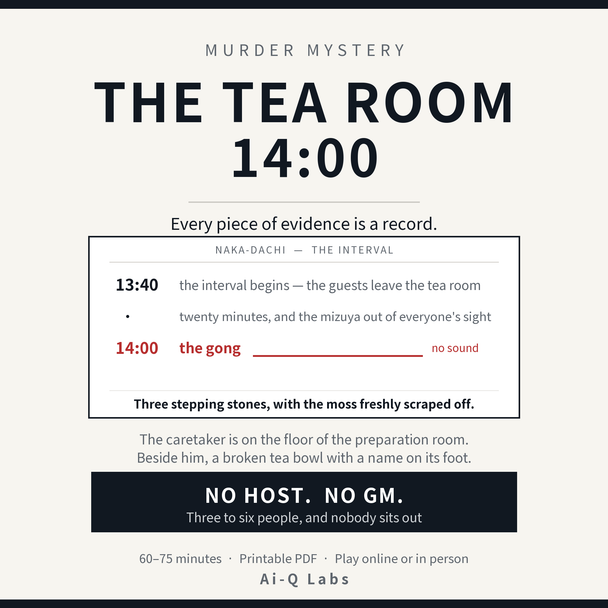
The Tea Room, 14:00 | Japanese-Style Murder Mystery for Exactly 3 Players, No Game Master | Printable PDF | 60-75 min





Description
THE TEA ROOM, 14:00 — a Japanese-style murder mystery for exactly 3 players, with no game master at all. 60–75 minutes. Printable PDF.
Kyoto, the northern edge of the city, where the mountains begin. A small tea house called Mushin-an — “the hermitage of no-mind”.
Once a year, a memorial gathering is held here. On the day of the previous owner’s death, the people she cared for in life are invited — no more than two of them, ever.
13:40 — the break in the middle of the ceremony. For twenty minutes, three people are in three different places. Each of them, alone.
At 14:00 the gong that calls the guests back does not sound.
Takashi Komai, who has kept the garden and the water here for thirty years, is on the floor of the preparation room. Beside him, a black tea bowl broken into six pieces. Its name is Mushin — the same name as this tea house. There is one bowl in the world with that name.
Fit the six pieces together and you have almost a bowl. Almost — because the ring on the very bottom, the part where a potter carves a mark, is missing.
THIS GAME HAS NO HOST
Most murder mysteries need someone to be the host, or the GM. That person reads the story, holds the clues, knows the truth — and cannot play. “A game for three” ends up needing four people in the room.
Not here.
- The story is carried by a Game Script that you read aloud, act by act
- Clues are opened together, at the start of each act
- The Solution sits in a separate file that you open last, together
Three people. That is the whole cast. Everyone plays.
WHY IT WORKS AS A CLASSROOM ACTIVITY
- Close reading with stakes. Every clue is a document students have to read carefully — a will kept in a drawer for three years, a kiln log from thirty years ago, a lesson diary with one line that has nothing to do with lessons. Missing one detail changes the answer.
- Evidence-based argument. Players make a claim, cite the document it came from, and defend it against the other readings at the table.
- Two win conditions, and the second is about honesty. Each player is hiding one thing. By the end of Act 2 all three must say it aloud. A group that solves the death but never admits its own secret does not win.
- No adult has to run it. A group of three can pick this up and play it without a teacher facilitating, which makes it usable as an independent small-group task.
WHAT YOU GET
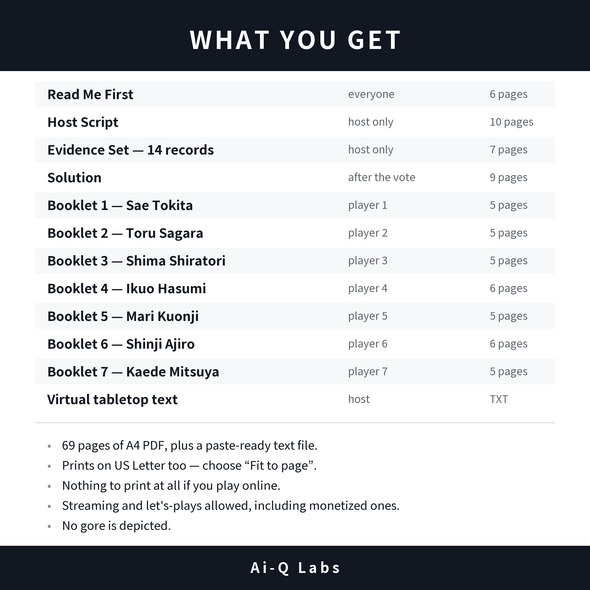
Read Me First (6 pages) · Game Script (5 pages) · three character booklets (5 pages each) · Act 1 clues · Act 2 clues · Solution, opened last (6 pages) · and a plain-text version for a video call. 40 pages of PDF. A4, prints fine on US Letter with “Fit to page”. Nothing to print at all if you play online.
You do not need to know anything about tea ceremony. About a dozen words carry the story, and each booklet explains the ones it uses on its last page.
BEFORE YOU BUY
- Exactly 3 players. Not 2, not 4. There is no host role
- Single use. Once you know the solution you cannot play it again — but you can hand it to a new group of three
- Deals with a death that was not intended, and with the five minutes that followed. No gore or violence is depicted. Suitable for high school and adult groups
- The tea house, the characters, the antique dealership — all invented. No real school of tea, kiln, family, place or business appears in this story
LICENSE
Classroom and club use is fine, including running it for as many groups as you like. Streaming and let’s-plays are allowed, monetized or not. Please do not redistribute or resell the files, claim authorship, or post the solution publicly.
HOW THIS WAS MADE
This scenario was written with the assistance of an AI language model (Claude, by Anthropic), then edited, structured, and consistency-checked by a human before release. The plot, characters, clue structure, and all text were reviewed by the maker.
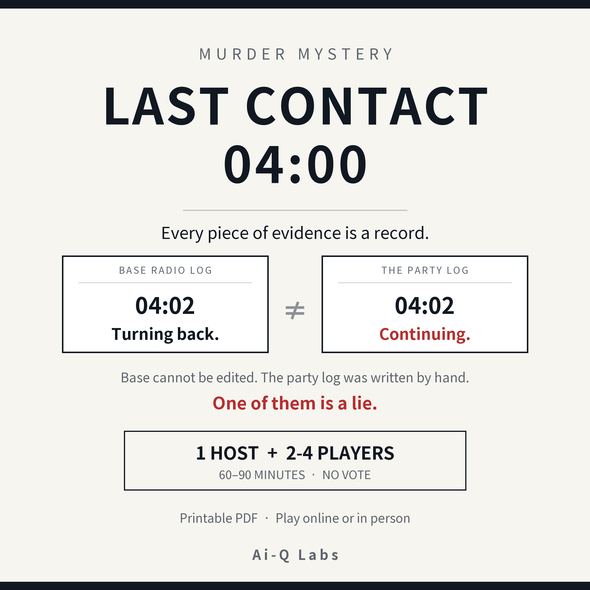
Ai-Q Labs makes murder mysteries in which all the evidence is text — a corrected page proof, a radio log, a weather record. Check out Ai-Q Labs for the rest of the series.
Related Products
Related Products
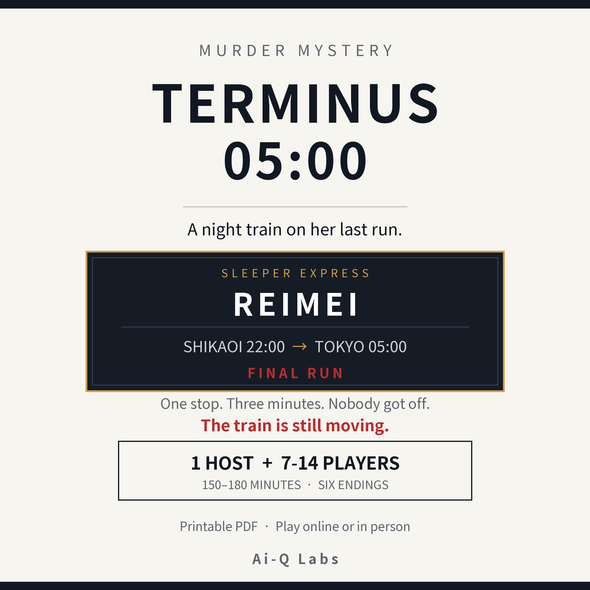
Terminus, 05:00 | Japanese-Style Murder Mystery for 7-14 Players + Host | Printable PDF | 150-180 min
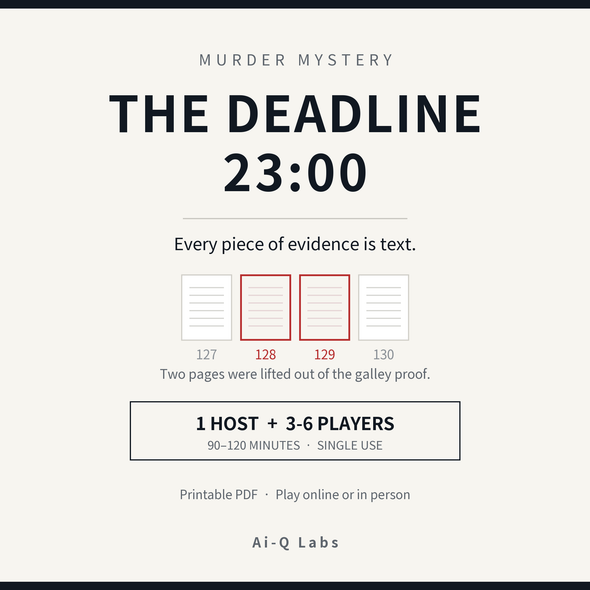
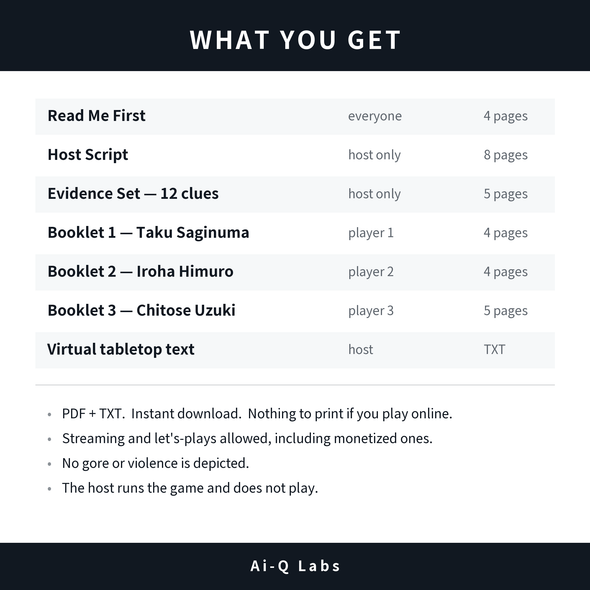
The Deadline, 23:00 | Japanese-Style Murder Mystery for 3-6 Players + Host | Printable PDF | 90-120 min
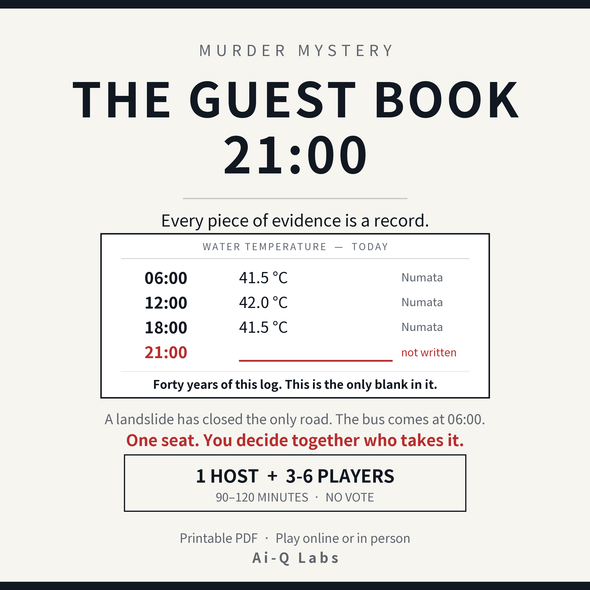

The Guest Book, 21:00 | Japanese-Style Murder Mystery for 3-6 Players + Host | Printable PDF | 90-120 min


First Light, 03:00 | Japanese-Style Murder Mystery for 3-6 Players + Host | Printable PDF | 90-120 min